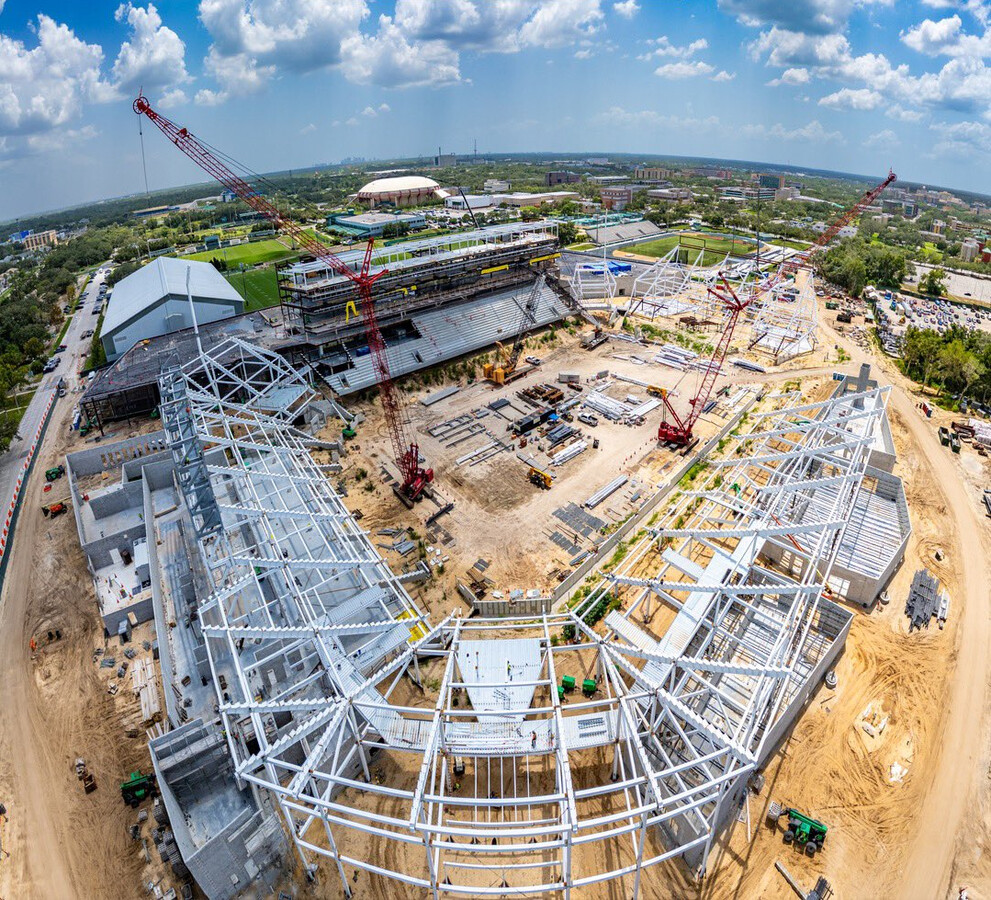
Not as much fun as demolition and construction photos but interesting SBJ article on the upcoming renovation at Florida and the decision making process:
https://www.sportsbusinessjournal.com/Ar...e-tension/
Renovation of The Swamp puts microscope on college sports facilities’ past-versus-future tension
By Bret McCormick
07.27.2026
Florida’s proposed $1.45 billion renovation of Ben Hill Griffin Stadium, better known as The Swamp, captures the moment in college sports facilities.
The university spent nearly 10 years studying what to do with its venerable stadium, which turns 100 years old in 2030, before announcing this summer that it will renovate The Swamp over the next three years in the most expensive college football stadium project ever.
The work entails a combination of deferred maintenance ($500 million worth) and general modernization, Americans with Disabilities Act compliance-inspired alterations, and the creation of additional revenue generators, like premium seating. Simply adding handrails to the aisles — necessary for ADA compliance — will ripple through the stadium’s seating bowl, requiring each aisle to be widened and some lower-bowl seats removed.
Florida’s journey to choosing renovation over a new stadium illustrates a central tension in college athletics facilities today: the tug-of-war between tradition and modernity, affordability and revenue generation, and college sports’ amateur past and its professional-looking present and future.
Project team
Architect of record: Crawford
Associate architect: Gensler
Contractor: Manhattan Construction/AECOM Hunt joint venture
Construction owners’ representative: Legends Global
Pre-construction owners’ representative: Canopy Team
Structural engineer: Thornton Tomasetti
Mechanical/electrical/plumbing/fire engineer: Henderson Engineers
Civil engineering: NV5
Food service: Duray
Technology: (PMY Group) WJHW
The Swamp’s renovation represents the first time a college sports venue project has topped the billion-dollar-threshold that’s been reserved for pro sports projects the last two decades.
Building a new stadium also easily could have cost Florida a billion dollars. Measuring what would have been lost if The Swamp was replaced is a fuzzier exercise. It sits in the middle of a Florida campus filled with palm trees, live oaks and buildings listed on the National Register of Historic Places. Aside from the field, the stadium is open daily to the public; students can jog up its seating bowl steps or plop down with a laptop on its benches. The Swamp’s orange wing walls, like its name, are instantly recognizable on college football game broadcasts.
“We did not want to come up with a plan that when you looked at the stadium, you weren’t sure where it was,” said Florida Athletic Director Scott Stricklin. “We think it’s one of the most unique venues in college football. You say [The Swamp and] people instantly know where you are.”
Florida thinks it found a solution that marries tradition with modern realities. The renovation will greatly improve basic fan experience aspects, providing wider concourses, more restrooms and hot cooking for the first time. And it’s expected to nearly double The Swamp’s annual revenue from $75 million to $145 million, thanks in large part to what will likely be more than a thousand new premium seats, though the final number hasn’t been finalized.
If approved this fall by the university’s board of governors, the project will at least double The Swamp’s 8% premium seating (of the venue’s total capacity), making it one of the most premium stadiums in college football.
Stricklin said Florida could have done, for half the price, a project that got it up to code and modernized the building, but shirked new revenue generation. Or it could have done the opposite, prioritizing new revenue.
It ultimately decided to do both.
“It’s either a go big or go home kind of moment for The Swamp,” Stricklin said.
The heart of campus
Tradition is one of the most powerful and differentiating facets of college sports, and surrendering that seems ill-advised. At the same time, some of college football’s century-old venues can’t meet the needs of an era that’s so vastly different from when they were built. Only one current SEC stadium was built later than the 1930s.
“Acknowledge that fan behavior has changed, the fan base has changed, recruiting matters more in college than it did once upon a time,” said Janet Marie Smith, co-founder and chairwoman of Canopy Team, which served as Florida’s owners’ rep during the pre-construction phase. “Families matter more. Our expectations for abundant restrooms, food and beverage, and places to retreat from the sun are all part of a different world than when The Swamp was built.”
As they were renovated over the years, many of the 100-year-plus-old stadiums became Frankensteinish amalgamations of various and disconnected additions. This renovation will be The Swamp’s eighth, and first since 2003.
One of the first steps for Crawford Architects, which has been working on Florida’s project since 2022, was to scan The Swamp with LIDAR and consolidate its paper and digital construction documents from the last hundred years into a unified digital 3D model.
“It’s a challenge, but I’ve been really surprised by how good the original structure is, considering its age,” said David Murphy, owner and senior principal of Crawford Architects. “Some of the newer additions and construction techniques — those 1990s and early 2000s structures — aren’t as good as the original ones.”
The renovation path
Florida’s predisposition toward renovating The Swamp was made clear by the project team it assembled.
Stricklin went to the same high school and university as his fellow Jackson, Miss., native, Smith, and long admired her contribution to sports venues. Smith’s firm was brought in for its expertise and interest in preserving historic sports venues, and its knack for harnessing the essential nature of a place and its culture within those stadiums.
Premium seating percentage comparison
Florida’s proposed renovation of Ben Hill Griffin Stadium should at least double the stadium’s 8% premium seating (of total capacity), which would put The Swamp among the most premium college football venues. Here’s how that percentage compares to other recently renovated (or under renovation) college football stadiums.
Neyland Stadium, Tennessee: from 4% to 7%
Booth Memorial Stadium, Kansas: from 2% to 8%
Beaver Stadium, Penn State (once completed): from 4.7% to 9.5%
Smith is most famous for her work on Camden Yards in the early 1990s, but was centrally involved in restorative renovations later to Fenway Park and Dodger Stadium. Reconnaissance visits to those historic ballparks informed Florida’s decision-making process, as did a September 2022 trip to Lambeau Field for a Bears-Packers game.
“Which is magical itself,” said Murphy, who was involved with Ellerbe Becket’s early-2000s renovation of Lambeau Field.
That Lambeau renovation added a premium seating structure atop the existing seating bowl. It ran counter to today’s trend of putting premium seating as close to the field as possible, but seeing Lambeau up close showed Stricklin and others a different approach that didn’t require blowing up The Swamp’s seating bowl.
“I would consider the field at Lambeau to be hallowed ground as much as The Swamp is,” Murphy said. “I just wanted to show to them that was a potential model.”
Canopy Team served as Florida’s historical preservation sherpa. If The Swamp was to be updated, which values, which facets of it were non-negotiable and which had some wiggle room? The orange wing walls — a visual identifier for the stadium similar to Fenway’s Green Monster — weren’t going anywhere.
Other questions were harder and epitomized college sports’ tug-of-war between past and future. Were The Swamp’s seating treads too narrow for modern fans, or were they worth keeping because they created the tight bowl that put fans on top of the action?
“Fans love the environment now,” Murphy said, providing the answer. “That steepness of the rake creates intimacy and contributes to that home-field advantage that’s legendary.”
Once Florida officials’ concerns about the financial viability of a renovation were assuaged by an ROI study, they decided to go that route. Financing hasn’t been secured — final approval from the board of governors is needed first — but will include a combination of donor support, capital reserves, revenue-backed bonding and long-term debt.
“Financial lenders recognize the sustainable nature of fan appetite for SEC football,” Stricklin said. “It’s a good bet. The following is so incredibly strong.”
No time like the present
That religious SEC following is demonstrated, in part, by premium seating demand. There is not a single suite in the SEC that’s currently available, based on the data Florida gathered during its research.
“There is probably an oversaturation point,” Stricklin said, “but nobody in the SEC has hit it yet.”
Florida will try to meet that demand through a Lambeau-like, two-story structure with its own concourse appended to the top of the current seating bowl. That structure should include an expanded variety of premium seating products and will help offset lower-bowl seat losses. The number of seats added is still to be determined.
Stadium seating capacities are diminishing in the NFL, but maintaining the overall capacity at 88,548 was important for Florida, in part because of the stadium’s 17,000-seat student section. Those seats go to a group that can drive the venue’s energy but also receive deeply discounted tickets and don’t have to donate to the university as part of their ticket price.
Premium seating will be a main driver of the near doubling of The Swamp’s annual revenue, as will natural ticket price increases based on the new seating products and inflation between now and 2030, when the project is completed. The stadium won’t close during the renovation; Manhattan Construction and AECOM Hunt will confine work to the college football offseason.
Naming-rights opportunities could generate further cash infusions, an option Florida hasn’t yet pursued.
And concessions revenue should grow considerably, thanks to The Swamp getting hot cooking for the first time. Most college football stadiums lack live cooking, with food often transported from other locations on game days.
But Sodexo Live — Florida’s athletic venues concessions partner — being able to cook and serve fresh food expands concessions possibilities well beyond what most college football venues generate, allowing universities to diversify price points, bring more local food joints (and culture) inside a stadium and create all-inclusive food and beverage tickets.
Improved concessions make “a huge impact, from premium to the GA ticket in the top of the building,” said Emily Hillery, Canopy Team senior project director, who led her company’s work on the Florida project.
After years of mulling The Swamp’s future, 2026 seems to finally be a year of action. Waiting any longer could mean more challenges to overcome. Consider the earthquakes that have hit college sports and sports venue construction — COVID-19, NIL, revenue sharing, tariffs and supply chain difficulties — in the nine years since Florida started studying the stadium’s future.
“Construction costs aren’t going to come down,” Stricklin said. “At some point, whether it’s The Swamp or some of the other venues we play in, they’re going to have to have this addressed some way, somehow.”
Renovating The Swamp
If approved by Florida’s board of governors this fall, work on the university’s $1.45 billion renovation of Ben Hill Griffin Stadium would begin in the 2027 offseason and be completed by fall 2030. The project’s basic elements include:
Restoring or replacing seating bowl concrete
Replacing mechanical systems, like HVAC, that have reached normal end-of-life
Seating bowl adjustments to reach ADA compliance, including widening the aisles and adding handrails
Widening concourses
Addition of a two-story premium seating structure atop the existing seating bowl
More concessions, including hot cooking
More and better restrooms
New video boards on the stadium’s north and south sides
New audio-visual tech

 /
Stadium Renovation and Construction Thread