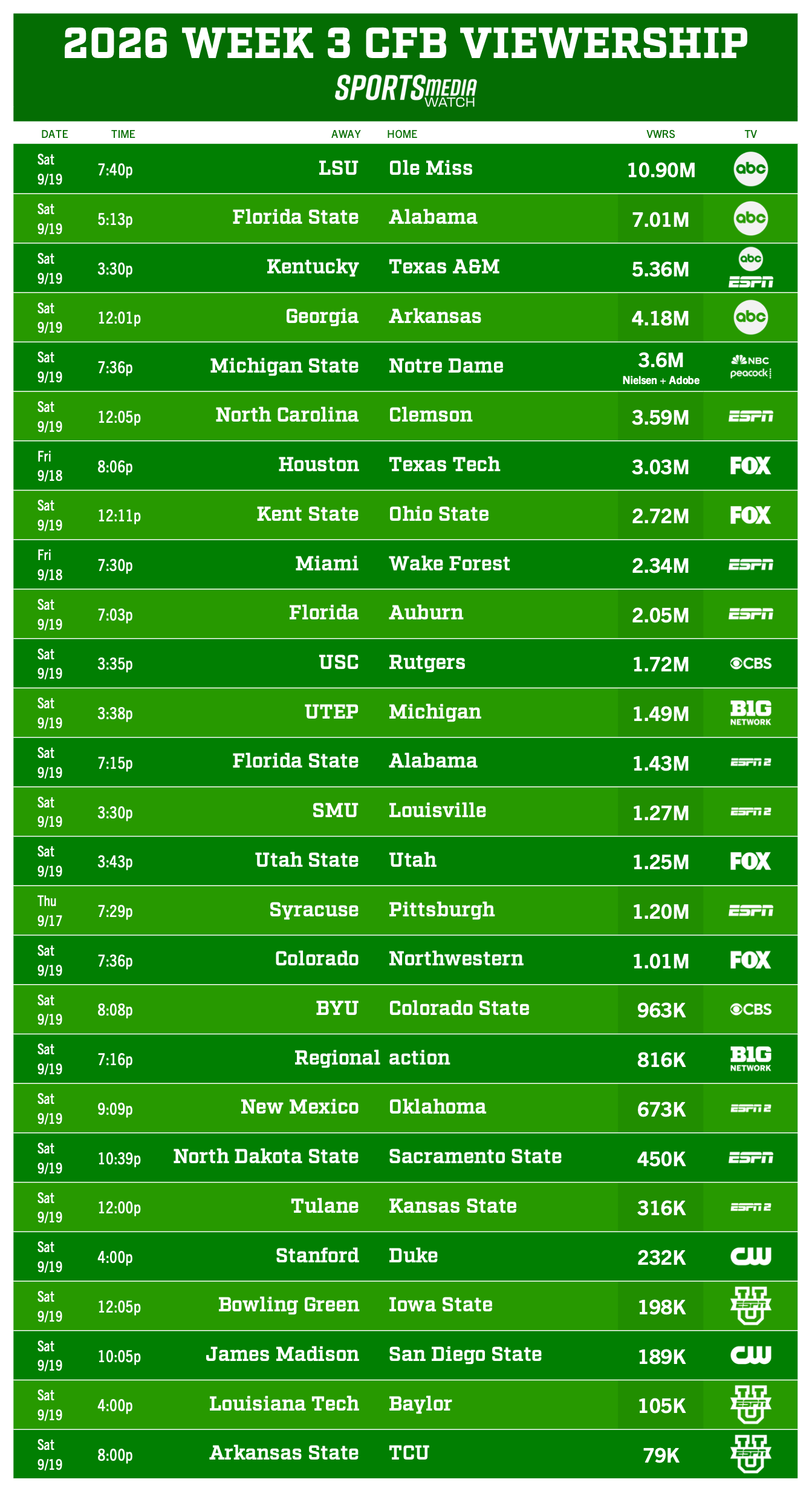
(09-30-2026 07:07 PM)bryanw1995 Wrote: (09-30-2026 05:56 PM)schmolik Wrote: None of the three Saturday Big Ten games got to 5 million viewers nor won their time slot but all did decent (3.7-4.6M).
I don't know if Illinois-Ohio State was the best game on paper last Saturday but Ohio State unarguably is the Big Ten's best draw. I would have loved to see that game against ABC's weakest game, Texas A&M-LSU. Last year Ohio State-Illinois got 5.28M against a slightly easier opponent (Missouri-Alabama, 6.99M, ABC's most watched 2025 noon game). Last year USC-Oregon got 5.43M and barely lost to Arkansas-Texas, 5.6M.
I said last week if the ABC and ESPN 3:30 games were split evenly CBS would have a chance. Not even close. Oklahoma-Georgia got just 2.6 million and all the SEC fans flocked to Ole Miss-Florida (last week they played like an Ole Miss). Oklahoma-Georgia was a blowout but Ole Miss-Florida wasn't that close either and Iowa-Michigan literally came down to the final play. In 2024 the same matchup got 3.82M viewers at noon in November (the game that cost Kiffin a Playoff spot). In 2025, they got 2.5M on ESPN prime time. All of a sudden Ole Miss-Florida is must see TV? It certainly helped following Texas-Tennessee and having it a week after the Kiffin Bowl.
If the Big Ten is going to beat the SEC head to head, it's all about matchups. Last year 46 games got 5 million or more viewers. 2025 was a 14 week season so there were 42 Saturday time slots between noon, 3:30pm, and prime time. Most Big Ten game that had 5 million or more viewers should have been able to win their time slots and few games that had less than 5 million or more viewers should have been able to win their time slots.
So in 2025:
Games where 2 or more 5M games went head to head:
9/27/25 7:30pm: Alabama/Georgia beat Oregon/Penn State
10/11/25 3:30pm: Oklahoma/Texas beat Indiana/Oregon
11/22/25 3:30pm: Arkansas/Texas beat USC/Oregon
9/20/25 3:30pm: Auburn/Oklahoma beat Michigan/Nebraska
10/11/25 noon: Missouri/Alabama beat Ohio State/Illinois
9/27/25 3:30pm: LSU/Mississippi beat Ohio State/Washington
The SEC/ABC won all six times! Oregon/Penn State of course got 8.5 million and lost to Alabama/Georgia (10.42 million). That was NBC's only Big Ten game over 5 million viewers and it still lost to the SEC and ABC. Heck, a Texas A&M/Notre Dame game got 6.2 million and also lost to the SEC/ABC.
Games where a sub 5M game won its time slot:
9/6/25 noon: Iowa State/Iowa
9/6/25 3:30pm: Mississippi/Kentucky
9/13/25 noon: Clemson/Georgia Tech
9/20/25 noon: Texas Tech/Utah
9/27/25 noon: Notre Dame/Arkansas
10/4/25 noon: Wisconsin/Michigan
11/1/25 7:30pm: Oklahoma/Tennessee
11/15/25 noon: South Carolina/Texas A&M
11/22/25 7:30pm: Tennessee/Florida
The SEC won five of these (one, SC/A&M, was on ESPN). The Big Ten only won once. Somehow the Big 12 lucked into winning two Big Nooners and the ACC won once.
Four times ABC had a 3:30pm or SNF game draw less than 5 million viewers (including Week 2 Mississippi-Kentucky) but three of those four games still won their time slots.
The Big Ten needs to find the Oklahoma/Tennessee's, Tennessee/Florida's, and Missouri/Texas A&M's (the only ABC 3:30pm game that lost its time slot last year) in the SEC's schedule and schedule their Oregon/Penn State games those weeks instead of scheduling them against Alabama/Georgia's. There is no reason an 8.5 million viewer game shouldn't win its time slot, it would have beaten all but five of ABC's 14 SNF games (not to mention if Oregon/Penn State went against a lesser game it most likely draws more than 8.5 million viewers). If Alabama always faces Ohio State while the SEC and Big Ten B teams face off, the SEC will always beat the Big Ten in the ratings. This week Ohio State is playing a ranked Iowa while we have a weak Florida-Missouri game. This is the matchup I want to see. If the Big Ten can't win this matchup this country is full of SEC diehards that would rather watch Mississippi State-Arkansas than Ohio State-Michigan.
Both games will get around 5m. Florida-Missouri is a real game that draws real interest beyond just SEC circles. Ohio St pulls 10m against Oregon, PSU, perhaps USC, and they draw 15-20m against Michigan. They pull 5m + against a host of other B1G schools. The B1G has plenty of quality contests available.
I really think that the 3 networks for 3 games on Saturdays really hurts ratings, in part b/c there's no lead-in from the previous game, and in part b/c there's no way to strategically ensure that games like Oregon-PSU don't go h2h with Alabama-Georgia, the closest thing that the SEC has to OSU-Michigan. Is the SEC a bigger ratings draw these days? Yes. Is it 50%+ better? Probably not.
Couldn't agree more. The ability to capture a carryover audience is a huge advantage compared to starting from scratch in every time slot. The added flexibility of not going head to head (Big Ten Game 1 vs. SEC Game 1, for example) would help significantly as well.
The challenge is that structures like that usually come with a financial tradeoff, such as being tied to a single network versus multiple partners. At the end of the day, the only reason we care about viewership is because it drives monetization. The SEC has clearly found the optimal structure for maximizing viewership. If monetization follows, they've found a very successful formula.
For the Big Ten, we may not be maximizing our viewership potential, but as long as we're continuing to monetize at a level that keeps pace with the SEC, the viewership gap isn't that concerning. We don't have to win every time slot. In fact, I think "winning time slots" is kind of a silly bragging rights metric. Given how the media deals are structured, I don't think the Big Ten will consistently win that battle anyway.
What matters is staying financially competitive, and that isn't really at risk for another decade. By then, conference realignment should have largely settled. In my opinion, the Big Ten's actionable opportunities aren't in changing the media structure. Financially, we're in a great position, and viewership remains strong when not measured exclusively against the SEC.
Instead, the focus should be on scheduling. The Big Ten should push for more marquee Friday night games, including Ohio State and Michigan, with no exceptions. It should also do a better job of capitalizing on peak early season interest by scheduling stronger nonconference matchups or compelling conference games. Fans are much more likely to get excited about Ohio State vs. Texas or Oregon vs. Penn State than USC vs. Rutgers in Week 1. The SEC has done an excellent job recognizing this and maximizing that opportunity.
People complain about Big Noon, but I think the Big Ten should focus on owning Friday nights (at least until the SEC decides to enter that window) and continue to embrace the noon slot. Put quality games in the 3:30 and 7:30 windows that can still draw around 4 million viewers on average. If the expectation is that the Big Ten should split window victories with the SEC 50/50 every week, fans are going to remain disappointed.
The SEC has both an enthusiasm advantage and a structural media deal advantage, and I think the latter is a bigger factor than many people realize. The Big Ten's job is to remain strategic and continue maximizing revenue. Right now, there are essentially two different approaches: one is optimized for financial outcomes (the Big Ten's more fragmented model), and the other is optimized for maximizing viewership (the SEC's consolidated model).
Likewise, the conferences themselves are built around different philosophies. I don't think one approach is inherently "winning" while the other is "losing." They simply have different strengths and weaknesses.
To me, the Big Ten's biggest long term risk is missing out on Miami. If the conference eventually expands to 20 teams and Miami is one of the additions that gets it there, I'd feel very good about the future. If the SEC somehow ends up with Florida State, Clemson, Miami, and North Carolina, then I'd be concerned.
But who wins more time slots from week to week doesn't worry me. The conferences are pursuing different strategies, and those strategies have a real impact on the numbers. That doesn't mean one approach is right and the other is wrong. They're simply playing different games.

 /
2026 College Football Ratings Thread