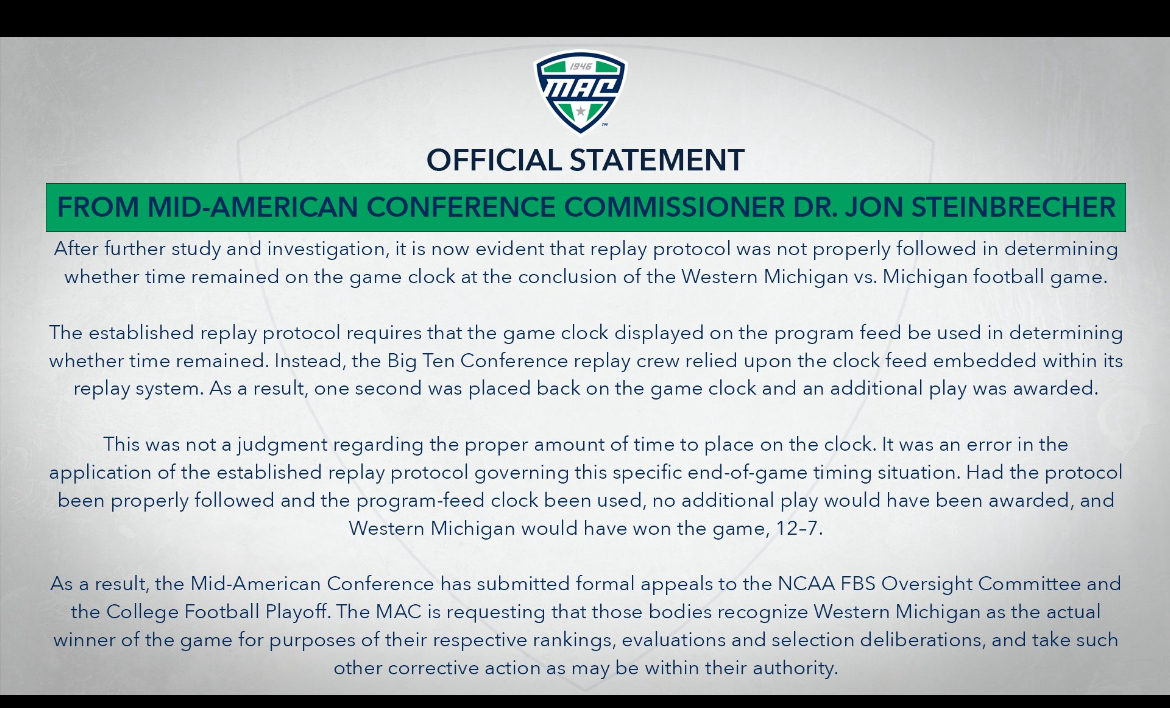
(09-09-2026 08:09 AM)wmubroncopilot Wrote: I'm just going to copy this over from what I just said on the MAC board-...
I'll share this from a different post, as well...
Not knowing the full inner workings of an NCAA replay room...
Scoreboard time originates from the press box using whatever control system each facility has. The majority of HS and college programs use Daktronics. There is a device called an "AllSport" that controls the time. All other instances of that time...scoreboard, video feed, etc...come from that device. While that clock is started by the onfield official and can be adjusted by the same official, the time being communicated to all subsequent devices down to whatever time resolution is displayed all originates from that device.
My interpretation would be that the stadium game clock is the time data that is visualized on in stadium displays, the program feed would be either the time data visualized in the production truck or the replay booth. Side note...in video production, there are two main "production windows". They are referred to as "preview" and "program" respectively.
The thing that has blown my mind about all of this is the idea of "camera synchronization strobes". All of the timing data is digital and communicated either hardwired or via wifi. Generally, the hardwiring if fiber optic where the signal is traveling quite literally at the speed of light. That system is really designed for the cameras to be synced with one another and have no bearing on how time is displayed.
Regardless, if patched directly into the data from the timing controller in the press box, there would NEVER be a time where one of the visual representations of time would reflect 0.00 PRIOR to the timing controller sending that data out.
The exception to this is if the timing resolution was set to something more precise than a full second (say hundredths) and the display software was set to the same, but "cut off" in the building of the scoreboard graphics. Say, the data reports at MM:SS.HH (minutes, seconds, hundredths), but the graphic was cropped to show MM:SS. It would still be receiving the time data, just not displaying it. So, 00:00.40 would reflect as 00:00 even with that .40 still left.
Alternatively, if the scoreboard graphic were built using a data field that was designed to show MM:SS, that piped in time data would still read 00:01 if that .40 was still in the data feed and not run down to 00:00 until the additional hundredths ran out.
This is actually a very simple mistake to make in building a scoreboard graphic. I've made of ton of them using our Daktronics equipment at Oxford. I'm not oversimplifying to tell you it is literally like building a Power Point of data fields. If the person in charge of the graphics package for UofM built the scoreboards using the MM:SS.HH instead of the MM:SS field by mistake, this could happen. It would also explain why one clock in the stadium would read 00:00 and another one would read 00:01. They used the two different data fields when building the boards.
The "official" time is controlled by the person in charge of the Daktronics console. What I would REALLY like to see is what all of the clocks read when it was reset to :09. If all three clocks were set to :09.00, the button press of the B1G person at the console SHOULD have started all three clocks. If they all were calibrated at :09.00, we should be able to see that as that was a static moment in time with no room for timing error.


 /
Broncos @ UM - Saturday 7 PM